Traces in the dark.
Loading the meteor calendar.

WILFRIED HILLER
The Book of Stars is a piano cycle composed by German composer Wilfried Hiller between 1962 and 2006. He has a home in Chrysomilia on the Greek island of Fourni. Here, the sea, the cicadas and the night sky inspired him to connect the 88 constellations with the 88 keys of the piano.
A digital concert hall connecting sky, island and music: each night, the selection follows the current starry sky above Fourni; by day, the southern sky opens up. In future, local weather will help shape the programme too.
TODAY’S CONCERT
Four constellations from the night sky above Fourni take centre stage. The selection changes with the date and the seasons — and so does the music that welcomes you here.
SKY AND WEATHER
Loading weather data.Rule-based curation: the weather shapes the concert title and introduction. The works follow the sky and a daily rotation. Automated AI selection is not yet active.
Four works · four reasons to listen
Explore the complete cycle · all 88 constellationsAn atlas of the southern sky, centred on the south celestial pole. It also reveals constellations that never rise above Fourni’s horizon.
Drag across the sky to look around. You can also pan the view with the arrow keys.
In tonight’s concertMore constellations
Classical figures for all 88 constellations · modern illustrations by Johan Meuris for Stellarium.
Calculated sky above Chrysomilia. The terrace orientation has not yet been surveyed. In the sky atlas, north is up and east is left. Clouds and terrain obstructions are not modelled. The Sun and Moon are enlarged for clarity.
The sky colours follow the Sun above Fourni: muted blue by day, warm tones at twilight and deep blue at night. Stars and constellation figures remain visible by day as a guide. The Sun and Moon appear at their calculated positions for Fourni; the Moon’s illuminated side follows the sunlight. Neither is drawn below the horizon. The Milky Way follows astronomical contours in the star catalogue, remains deliberately subtle and fades in daylight. The view starts at the current local time and updates hourly. A preview time you choose is retained. The day concert runs from 06:00 to 18:00 and rotates through the southern works; the night concert runs from 18:00 to 06:00 and follows the sky above Fourni at 22:00. All times are local to Fourni, including daylight saving time. The southern atlas is a polar map rather than a view from the terrace. Its stars, Sun and Moon are recalculated for that southern perspective, while the lighting continues to follow local time on Fourni.
Milky Way contours: d3-celestial / José R. Vieira · Astronomical calculations: Astronomy Engine
FLEETING ENCOUNTERS IN THE SKY
Some lights linger for only a moment. Discover meteor showers and the quiet journeys of space stations.
Loading the meteor calendar.
Checking current orbital data.
A single request connects your browser to CelesTrak in the United States, transmitting your IP address and browser data. Equivalent data protection is not always guaranteed; US authorities may access data and your legal remedies may be limited. Permission is voluntary.
Für ISS und Tiangong berechnen wir aus CelesTrak-Bahndaten die nächsten maximal 48 Stunden. Gezeigt werden beleuchtete Abschnitte bei einer Sonne mindestens 6° unter dem Horizont, einer Station mindestens 10° hoch und einem höchsten Stand von mindestens 20°. Die Sichtbarkeit hängt zusätzlich von Helligkeit, Wolken und freiem Blick ab. Bahndaten älter als 72 Stunden werden nicht verwendet. Der externe Abruf erfolgt nur auf Ihre ausdrückliche Anfrage und höchstens alle zwei Stunden je Seitenaufruf. Ohne Freigabe nutzen wir den mitgelieferten Datenstand, solange er aktuell genug ist.
For meteors, we show seasonal activity periods from the IMO calendars for 2026/2027. In other years, the dates are only annual guidelines. Radiants indicate approximate directions of origin, not predictions of individual streaks. The Moon’s position and illumination are calculated for the stated time using Astronomy Engine; weather model data does not guarantee visibility on site.
Orbital data: CelesTrakMeteor calendar: IMOOrbit calculations: satellite.jsLunar calculations: Astronomy Engine
A VIEW OF FOURNI
This is the sea and sky Wilfried Hiller looked out upon while composing on Fourni. In Book of Stars that sense of boundless space continues to resonate.
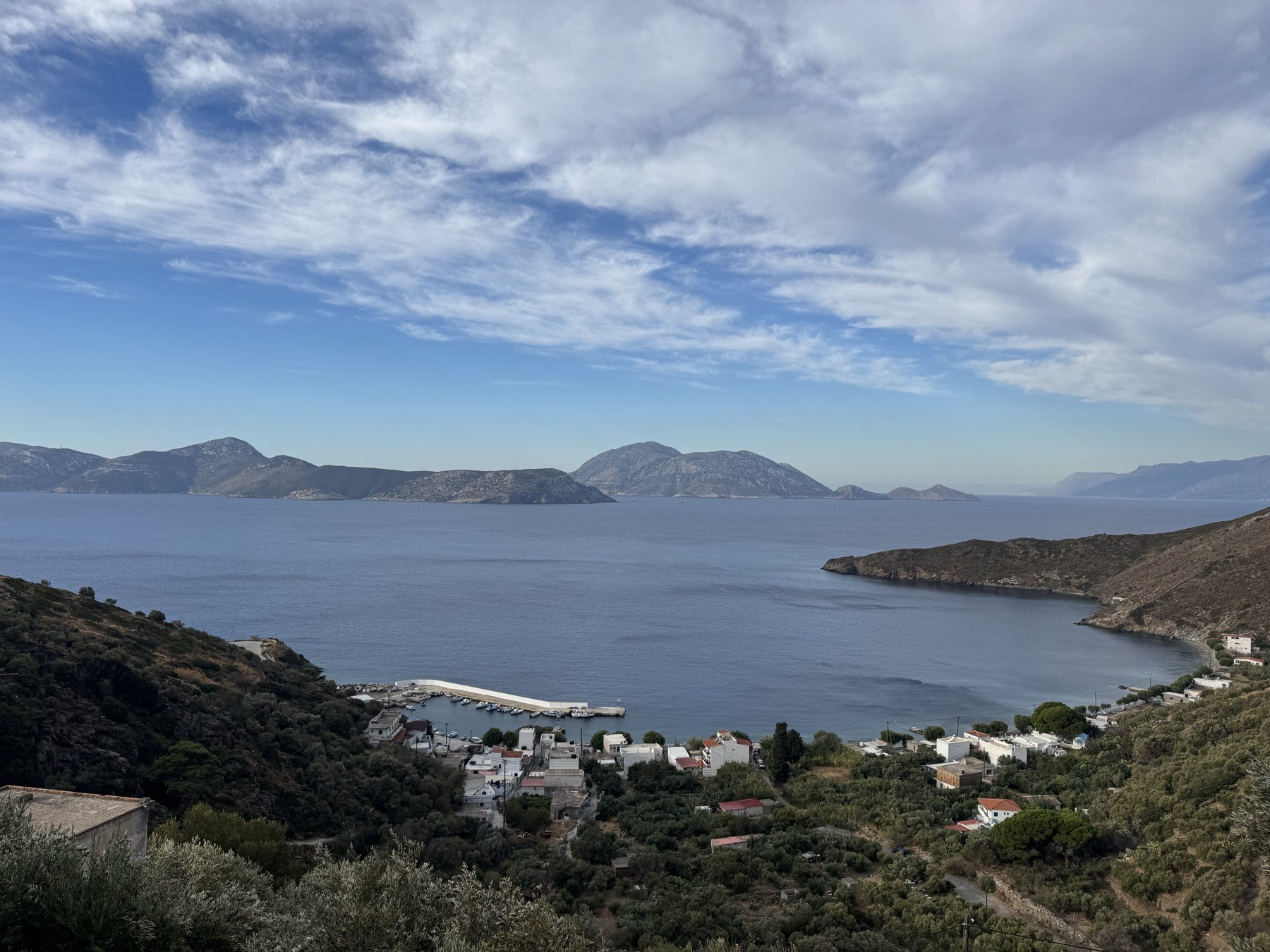
Sea. Light. Open space.
Fourni · Aegean SeaData from MET Norway · CC BY 4.0 · Model data, not station measurements
The view of the bay is a photograph. Weather data comes from MET Norway’s forecast model for Chrysomilia (37.63° N, 26.51° E). The display advances to the current model hour every hour; new data is retrieved roughly every three hours. Rain refers to the following hour. Measurements from our own weather station will be added later.
THE PLACE BEHIND THE MUSIC
Fourni is the largest island of the small Fourni Korseon archipelago in the northern Aegean, between Samos and Ikaria. Rocky shores, sheltered coves and small fishing harbours shape its character. For centuries, everyday life here has followed the sea.
Ancient quarries and archaeological remains on land tell of the islands’ long history along the trading routes of the Aegean.
Chrysomilia lies in the north of Fourni. The houses of this small fishing village nestle on the hillside above the bay, with the harbour and beach below. Here, the view of the sea and the openness of the sky belong together.
Traces of a Hellenistic settlement survive at Agia Triada. For Wilfried Hiller, the area also became a deeply personal place of inspiration: in his introduction to Ara, he describes the little Church of the Holy Trinity as the ‘Pearl of Chrysomilea’.
Read Wilfried Hiller’s introduction to AraBetween 2015 and 2025, 62 shipwrecks were documented in the waters of the archipelago. Dating from the sixth century BC to the interwar period, they preserve roughly two and a half millennia of seafaring history. The archaeological sites form part of Greece’s protected underwater cultural heritage.
The Korseai Institute’s research report of 22 October 2026 also gives this total for 2015–2025.
Above the sea, the constellations tell stories; below, the wrecks preserve the memories of earlier seafarers. In this concert hall, sky, sea and history meet today.
The 2026 expedition continued the excavation of Shipwreck 15 off Aspros Kavos. The Early Byzantine merchant vessel, dating to the fifth–sixth centuries AD, lies at a depth of around 43–49 metres. Its amphorae and tableware tell of trading connections between the Black Sea, the Aegean and the eastern Mediterranean.
The NOUS camera portal lets you explore the underwater world at Shipwreck 15 and the shores of the archipelago. During fieldwork, you may even be able to watch the excavation in progress.
NOUS · open the underwater camerasSelect ‘PLAY ALL’ or an individual camera in the portal. Feed availability can vary; some locations are currently paused.
Background and sources: Visit Greece · FourniAncient traces on FourniUnderwater heritage · protection and research
THE COMPLETE SKY
Explore Book of Stars in its original sequence, with Wilfried Hiller’s original titles preserved alongside their English translations. Select an entry to discover the music of the constellations. In his introductions, Wilfried Hiller shares the myths, images and personal memories behind the pieces. Under “Stories in the sky”, discover the myths and astronomical discoveries associated with each constellation.
Open a collection or search for a particular constellation.
No matching constellation found.
ORIGINS · REFLECTIONS · RECORDING
With Berenice’s Hair the cycle began in 1962. From 1996 onwards, the starry sky above Fourni gave Wilfried Hiller the decisive inspiration to develop it into an entire musical cosmos.
The 88 constellations come together in 72 compositions. Some share a story and therefore also meet within a single piece.
Wilfried Hiller brings related constellations together in musical scenes. The opening work, Mensa — Lacaille on Table Mountain already unites eleven constellations, their motifs linked by an ascending song of the stars.
Argo — The Ship of the Argonauts brings together the ship’s stern, keel and sails with the dove that guides it to safety. Other connections link the Hare and the Raven, and the Serpent Bearer and the Serpent. Hiller composed both the Dove and the Lyre from two different perspectives.
From the composer’s accompanying essay, September 2006
Wilfried Hiller · Chrysomilia, Fourni, September 2006
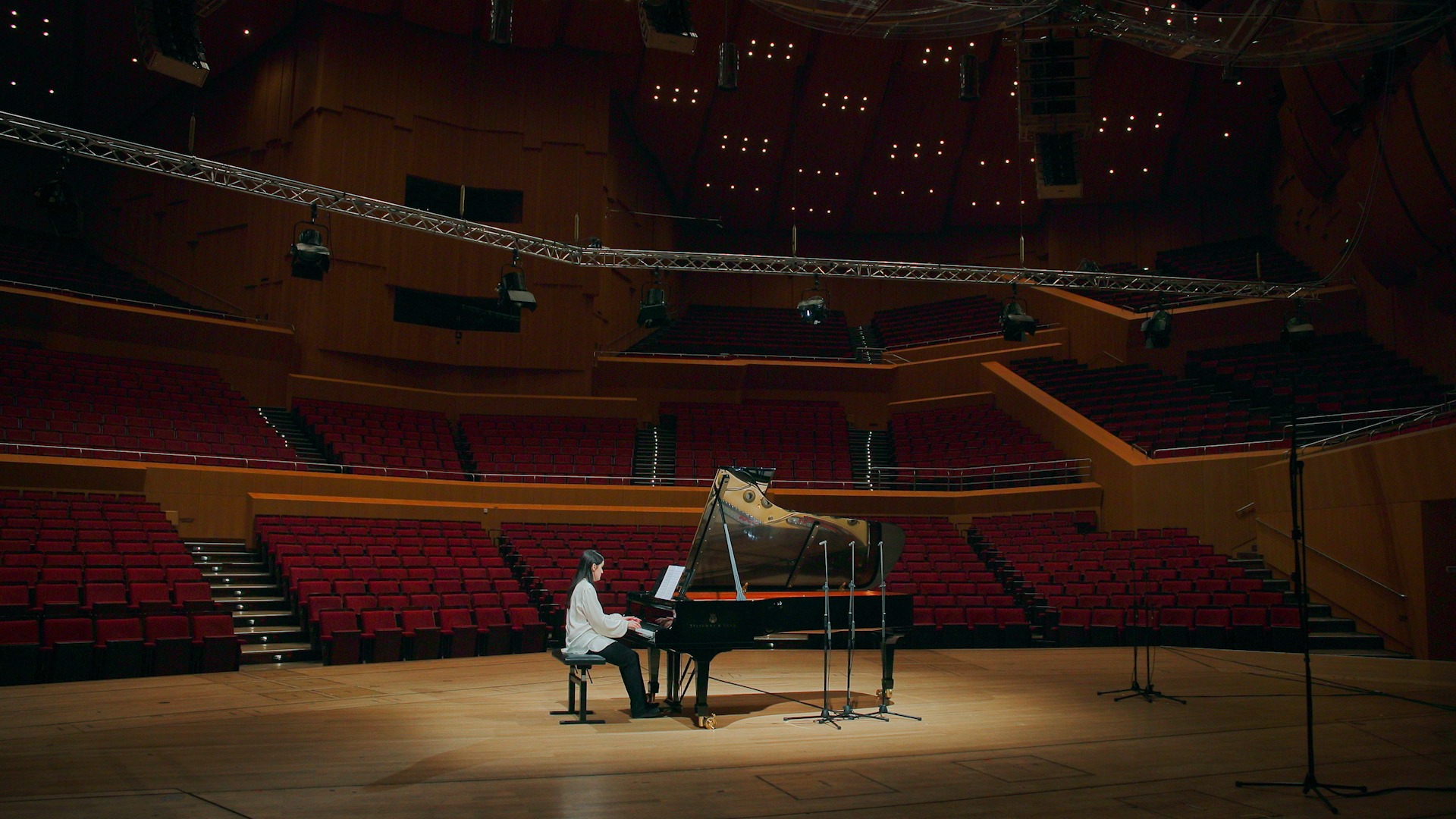
PHILHARMONIE MUNICH · 2021
Tanja Huppert · Piano
Dolby Atmos · Dolby Vision
With support from Steinway & Sons, Gasteig Munich, Dolby and Musikverlag Eckart Rahn.
These traditional motifs are modern illustrations by Johan Meuris for Stellarium, rather than historical engravings. All 88 constellations are represented. The Stern, Keel and Sails share the ship Argo; the Serpent Bearer and Serpent share a single figure.
The image files are licensed under the Free Art License. The map uses a transparent gold tint, an adaptation covered by the same licence. The unchanged originals remain available; star anchors and alignment data follow the CC-BY-SA terms stated in the Original source . Image credits and original files